
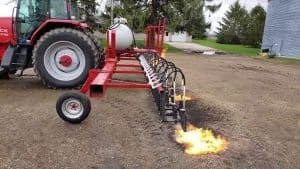
Flame weeding has been used successfully in organic farming systems for decades, yet there is still widespread confusion about how it actually works—and what design features truly matter in the field.
Much of that confusion comes from focusing on what flame weeding looks like, instead of understanding how flame weeding kills weeds.
This article explains the fundamentals of flame weeding so organic growers evaluating flame weeders for row crops can make decisions based on biology and real field performance, not assumptions or marketing claims.
What Is Flame Weeding?
Flame weeding is a thermal weed control method that uses intense heat to damage plant tissue and kill weeds without chemicals. It is commonly used in certified-organic production and other systems where chemical herbicides are not permitted or effective.
The key point is this: flame weeding works because of heat, not because weeds are burned or incinerated.
Flame Weeding Does Not “Burn” Weeds
One of the most common misconceptions about flame weeding is that weeds are killed by being burned.
In reality, flame weeding kills weeds through rapid heat shock.
When plant tissue is exposed to high heat—even briefly—the water inside plant cells expands rapidly, rupturing the cell walls. Once those cells are damaged, the plant can no longer regulate moisture or photosynthesis, and it dies.
This process happens extremely fast. In most cases, effective weed kill occurs in fractions of a second.
More flame exposure beyond that point does not improve weed control. It simply increases fuel use and visual scorching without changing the biological outcome.
Kill Happens at the Torch, Not Inside a Hood
Because flame weeding relies on instantaneous heat shock, the most important factors for effective weed control are:
-
Temperature at the point of contact
-
Precise placement of the flame relative to the weed
-
Consistency across rows and changing field conditions
Once the required heat threshold is met, additional containment does not increase weed kill.
This is why experienced operators often rely on simple field checks—such as pinching or crushing leaf tissue after flaming—rather than judging success by how charred a weed appears.
Effective flame weeding is about precision, not prolonged flame exposure.
When Is Flame Weeding Most Effective?
Flame weeding is most effective on young weeds, particularly small annual broadleaf species before they develop thick stems or extensive root systems.
Timing matters. Weeds that are small and actively growing are more susceptible to thermal damage, while larger or perennial weeds may require repeated passes or integration with other weed-management practices.
For organic growers, success comes from using flame weeding strategically, not expecting it to solve every weed problem in a single pass.
What Matters Most in Organic Row-Crop Flame Weeding
For organic row-crop growers, the real challenge is not whether flame weeding works—it does.
The challenge is maintaining consistent weed control across the season, despite real-world variables such as:
-
Narrow and unpredictable timing windows
-
Weather variability
-
Crops moving through different growth stages
-
Labor and equipment availability
-
Field-to-field differences
A flame-weeding system must be adaptable and predictable, not just effective during a single ideal pass. This is where overall system design becomes more important than individual features.
Do You Need Hoods for Flame Weeding?
Some flame-weeding systems use hoods to manage flame direction and visibility. In certain situations, hoods can be useful—particularly for newer operators or very specific applications.
However, hoods do not increase weed kill once the required heat threshold is reached.
They also introduce tradeoffs that matter at scale in organic row-crop production, including:
-
Added weight
-
Reduced flexibility as crops grow
-
Increased complexity and maintenance
-
Optimization for a narrow growth stage
For organic growers managing acreage across multiple crop stages, these tradeoffs often limit usefulness outside a specific window.
Hoods are one design choice—not a requirement for effective flame weeding.
Control and Placement Matter More Than Hardware
In real field conditions, consistent flame-weeding results come from:
-
Accurate torch placement
-
Proper flame angle and pressure
-
Operator control
-
Equipment designed to adapt as crops develop
That’s why some flame-weeding systems prioritize control and adjustability over containment. The goal is not to hide the flame—it’s to apply heat exactly where it’s needed, reliably, under changing conditions.
When that’s done correctly, flame weeding remains effective without unnecessary hardware or complexity.
Does Flame Weeding Kill Roots?
Flame weeding primarily kills the above-ground portion of weeds. While repeated applications can weaken some plants over time, flame weeding does not always eliminate deep perennial root systems in a single pass.
For this reason, flame weeding is most effective when used as part of a broader organic weed-management strategy rather than as a standalone solution for perennial weeds.
Flame Weeding in an Organic Weed-Management System
Flame weeding works best when integrated with other organic practices such as:
-
Stale seedbed preparation
-
Mechanical cultivation
-
Crop rotation
-
Timely field passes
Organic weed control is about systems, not silver bullets. Flame weeding is a powerful tool within that system when applied with the right expectations and equipment.
How to Evaluate Flame Weeders for Organic Farming
When comparing flame weeders for organic row crops, the most useful question isn’t:
“Does it have hoods?”
A better question is:
“Does this flame-weeding system give me control across the season, under real field conditions?”
That shift—from focusing on features to focusing on function—is where good equipment decisions are made.
Final Thoughts on Flame Weeding Effectiveness
Flame weeding is a proven weed-control method in organic agriculture. The biology behind it is well understood. Differences between flame weeders come down to design philosophy, not marketing language.
Understanding what actually kills weeds—and what doesn’t—helps organic growers choose equipment that fits how they farm, not just how a machine looks in a brochure.
When evaluating flame weeders for organic row crops, focus on:
-
Control
-
Placement
-
Adaptability
-
Season-long usefulness
Everything else is secondary.